Whole Home Air Filtration: 5 Options for Your HVAC System
If you have central heating and air, you already have the bones of whole home air filtration. Every time your system runs, it pulls air from every room through one spot. Put the right filter there and you clean the air for the whole house, not just one room.
The catch is that not every option works with every system. A filter that’s too dense for your blower can cut airflow, raise your energy bill, and strain your equipment. Here are the five main options, what each one does well, and how to tell which one fits your setup.
Whole home air filtration options compared
| Option | Typical rating | Effect on airflow | Upkeep | Best for |
|---|---|---|---|---|
| Upgraded 1-inch pleated filter | MERV 8–13 | Low at MERV 8, can be high at MERV 13 | Replace every 1–3 months | A quick, low-cost upgrade on a healthy system |
| 4- to 5-inch media air cleaner | MERV 11–16 | Low for its rating, thanks to more surface area | Replace about every 6–12 months | Most homes looking for a real, lasting upgrade |
| Electronic air cleaner | High efficiency on fine particles | Low | Wash the collector cells every few months | Homeowners who prefer washable over disposable |
| HEPA bypass system | HEPA, 99.97% at 0.3 microns | None added to the main system (has its own fan) | Pre-filter and HEPA changes, higher cost | Severe allergies or asthma, or very high filtration goals |
| UV lights | Not a particle filter | None | Replace bulbs about yearly | Keeping the coil clean, paired with a good filter |
The 5 whole home air filtration options
1. An upgraded 1-inch pleated filter
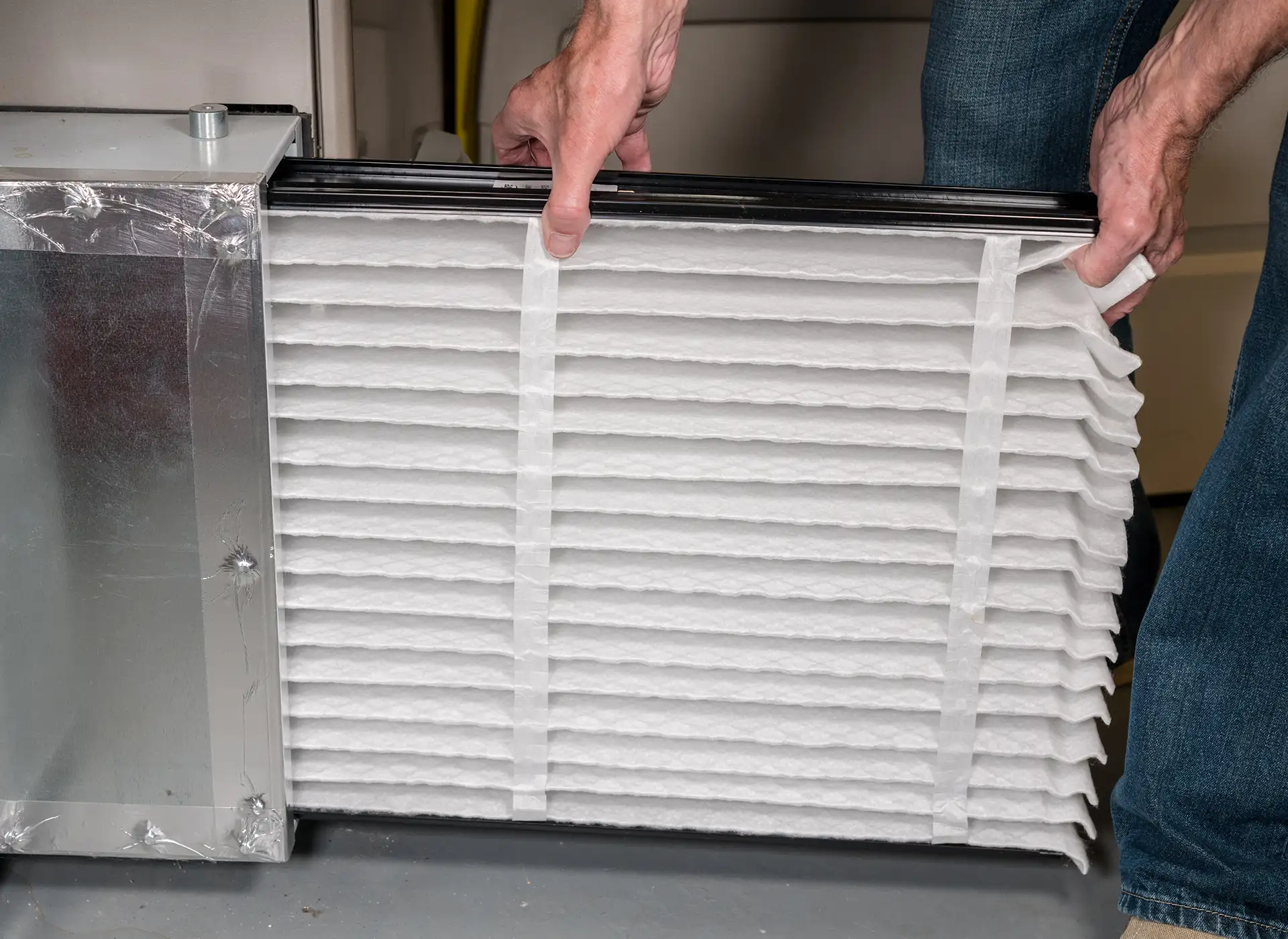
This is the simplest step. You swap the thin fiberglass filter for a pleated one with a higher MERV rating. MERV (Minimum Efficiency Reporting Value) measures how well a filter catches particles. Higher numbers catch smaller particles.
The EPA’s Guide to Air Cleaners in the Home suggests a filter rated at least MERV 13, or as high as your system fan and filter slot can accommodate. That last part matters. In a 1-inch slot, a MERV 13 filter is dense, and some older or undersized systems struggle to push air through it. A MERV 8 to 11 filter is often the practical ceiling for a 1-inch slot until a tech checks your system.
2. A 4- to 5-inch media air cleaner
This is the upgrade we recommend most often. A media air cleaner is a cabinet installed in the return duct next to your furnace or air handler. It holds a deep, pleated filter, typically MERV 11 to 16.
Because the filter is folded into a much deeper box, it has several times the surface area of a 1-inch filter. Air moves through it more slowly and easily. You get high-MERV filtration with much less airflow restriction, and filters typically last 6 to 12 months instead of 1 to 3.
3. An electronic air cleaner
Electronic air cleaners (also called electrostatic precipitators) give particles an electrical charge, then catch them on oppositely charged collector plates. They’re efficient on fine particles and add little airflow resistance. Instead of buying filters, you wash the collector cells every few months.
One caution: the EPA notes that electronic air cleaners, ionizers, and some UV and plasma devices can produce ozone, which is a lung irritant. If you go this route, choose a model designed for low or no ozone output and keep up with cleaning.
4. A HEPA bypass system
True HEPA media catches 99.97% of particles as small as 0.3 microns. HEPA is too dense to put directly in the path of a home HVAC system. Instead, a bypass unit is mounted on the return duct with its own fan. It pulls part of the airflow through the HEPA filter and sends it back. Because it runs in parallel, it adds no static pressure to your main system.
It’s the highest level of filtration, and it costs the most to install and maintain. It makes the most sense for households managing severe allergies or asthma.
5. UV lights (an add-on, not a filter)
UV lights installed near the indoor coil help keep mold and bacteria from growing on the damp coil surface. They don’t catch dust, pollen, or dander. Think of UV as something to add next to a good filter, never a replacement for one. Choose lamps rated as ozone-free.
What to skip: ozone generators and “air purifiers” that make ozone
Some products sold as air purifiers produce ozone on purpose, sometimes marketed as “activated oxygen” or “energized oxygen.” The EPA warns against air cleaners that intentionally produce ozone, because ozone is a lung irritant. No whole-home filtration upgrade needs them.
How to choose whole home air filtration for your system
The best filter is the most efficient one your system can actually handle. Four things decide that.
- Your filter slot. A 1-inch slot limits how much filtration you can add without restricting airflow. If you want MERV 13 or higher, a media cabinet is usually the better path.
- Your blower and static pressure. Every filter adds some resistance. A technician can measure static pressure across your system with a manometer to see how much room you have. Older systems and undersized return ducts often have less room than you’d think.
- Your ductwork. If return ducts leak, unfiltered air from the attic or crawlspace slips in after the filter. Even the best filter can’t catch it. Sealing returns is often part of a good filtration upgrade.
- Your goals. For general dust, a media air cleaner is plenty for most homes. For severe allergies or asthma, a HEPA bypass may be worth the extra cost. Ask your doctor what matters for your household.
One thing filtration won’t do is replace source control and ventilation. The EPA is clear that filters help but can’t remove every pollutant. Keep up with vacuuming, run bath and kitchen fans, and keep humidity between 30% and 50%.
What a whole home air filtration upgrade looks like
When Breathe Easy Heating and Cooling evaluates a home for whole home air filtration, we:
- Check your current filter, filter slot, and how well it seals
- Measure static pressure to see how much filtration your system can handle
- Inspect accessible return ductwork for leaks and gaps
- Recommend the option that fits your system and goals, from a better filter to a media cabinet or HEPA bypass
- Install it, seal it properly, and show you how to maintain it
If an inspection turns up heavy buildup inside the ducts, we’ll tell you. In that case, clean the ducts before installing new filtration, so the new filter isn’t fighting old debris from day one. Owner Brian Eberly holds a Virginia Class A HVAC license and NADCA certification, so the ducts and the equipment get checked in the same visit. We serve Fredericksburg VA, Spotsylvania, Stafford, King George, and Caroline County.
Frequently asked questions
For most homes, a 4- to 5-inch media air cleaner with a MERV 11 to 13 filter is the best balance. It filters well, has little effect on airflow, and needs a new filter only once or twice a year. HEPA bypass systems filter more but cost more.
Many can, but not all, especially in a 1-inch slot. The EPA suggests MERV 13 or the highest rating your system can accommodate. A technician can measure static pressure to tell you for sure.
They do different jobs. Whole-home filtration cleans air throughout the house whenever the system runs. A portable HEPA unit cleans one room. Many allergy-conscious households use both, with a portable unit in the bedroom.
Some can. The EPA notes that electronic air cleaners, ionizers, and some UV and plasma devices may emit ozone. Choose models designed for low or no ozone, and avoid ozone generators entirely.
Only if an inspection shows heavy buildup or debris. If it does, cleaning first gives the new system a clean start.
Find the right whole home air filtration for your home
We’ll check your system, measure what it can handle, and recommend an option that fits your home and your budget, with no upselling.
When It Comes to Your Family’s Comfort, You Can Breathe Easy.
Book an evaluation or call 540-656-9441.